
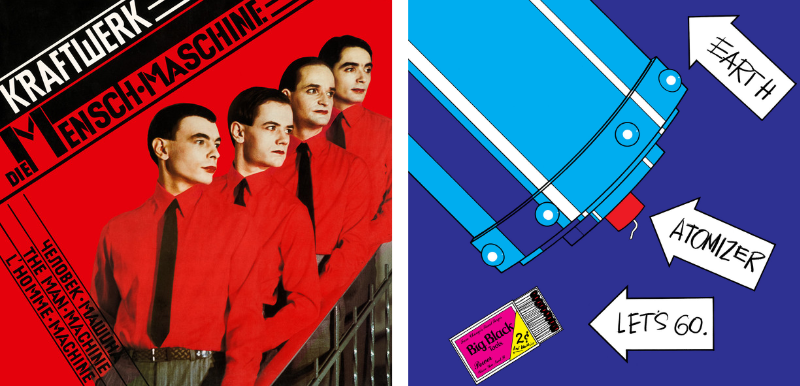
When The Man-Machine appeared in 1978, Kraftwerk had already spent years refining an aesthetic in which technology wasn't simply a tool—it was the subject itself. Working from their legendary Kling Klang Studio in Düsseldorf, Ralf Hütter and Florian Schneider pursued immaculate, almost architectural recordings. Sequencers, drum machines, vocoders, and custom-built electronic instruments were recorded with extraordinary attention to detail, creating music that felt simultaneously futuristic and strangely emotional.
Much of that precision came from studio discipline rather than expensive gear alone. Kling Klang functioned almost like an instrument itself, with custom modifications, synchronized sequencing systems, and meticulous editing long before digital workstations made such workflows commonplace. Producer Conny Plank had helped shape Kraftwerk's earlier records before the band assumed complete production control, and his influence—careful microphone placement, creative signal processing, and an openness to experimentation—remained part of the German electronic tradition even after their collaboration ended.
Eight years later, Steve Albini's Atomizer sounded like it had arrived from another planet. Rather than warm, overdriven rock guitars, Big Black favored metallic, cutting tones, a relentless Roland TR-606 drum machine ("Roland"), and performances locked to mechanical precision. Albini often described the drum machine not as a compromise but as an artistic choice. The inhuman consistency became part of the band's identity, stripping away the swing and looseness of conventional rock in favor of something cold, confrontational, and industrial.
This is where Kraftwerk's influence becomes less about sound and more about philosophy. Big Black never attempted to imitate Kraftwerk's melodies or synthesizer textures. Instead, they embraced a similar idea: that machines could become equal creative partners rather than mere substitutes for human musicians. Both bands rejected traditional rock authenticity in favor of calculated precision, albeit with radically different emotional outcomes. Kraftwerk's machines suggested optimism and modernity; Big Black's suggested alienation, violence, and urban decay.
Several important records connect these worlds. David Bowie's Low (1977), produced with Tony Visconti and heavily influenced by Berlin's electronic scene, introduced many rock listeners to minimalist electronics and motorik rhythms. Brian Eno's collaborations with Bowie and his own ambient work demonstrated that studio manipulation could become composition itself. Joy Division's Unknown Pleasures (1979), produced by Martin Hannett, used gated ambience, unusual microphone techniques, and extensive processing to make conventional rock instruments feel ghostly and mechanical. Cabaret Voltaire, Throbbing Gristle, and Chrome further blurred the line between electronic experimentation and aggressive rock, while Killing Joke and early Ministry translated industrial textures into heavier guitar music.
Even the production philosophies evolved along this lineage. Hannett famously treated the recording studio as an instrument, placing microphones in hallways, stairwells, and unexpected spaces. Albini, by contrast, would later become known for the opposite approach: capturing bands with minimal processing, emphasizing room acoustics, transient detail, and performance over post-production. Yet Atomizer occupies an interesting middle ground. Although Albini would later champion naturalistic recording under the name Electrical Audio, Big Black's early records are full of deliberate artifice: drum machines, aggressive distortion, unusual guitar EQ, and dense layering that creates an almost industrial wall of sound.
The equipment itself tells part of the story. Kraftwerk's arsenal included synthesizers such as the Minimoog, ARP Odyssey, EMS Synthi AKS, and custom-built sequencers, alongside vocoders and early digital rhythm systems. Their recordings increasingly benefited from emerging multitrack recording technology, high-quality German broadcast equipment, and painstaking tape editing. Big Black's setup was comparatively modest but no less inventive. Albini favored inexpensive solid-state amplifiers, aluminum-neck Travis Bean guitars, aggressive distortion pedals, and the Roland TR-606. Rather than pursuing "vintage warmth," he chased clarity, attack, and unpleasantness—turning limitations into a defining aesthetic.
One overlooked connection between the albums is their relationship with repetition. Kraftwerk inherited minimalist ideas from composers like Steve Reich and the motorik pulse of Neu!, reducing musical gestures to hypnotic loops. Big Black applied a similar structural discipline to punk and noise rock. Riffs repeat with almost programmed insistence, while the drum machine refuses to fluctuate. The result is music that feels less performed than manufactured.
Perhaps the most fascinating historical twist is that many of the genres inspired by Kraftwerk eventually fed back into heavy music. Electro, hip-hop, industrial, EBM, techno, and synth-pop all borrowed elements from The Man-Machine. By the mid-1980s, musicians across punk, post-punk, and industrial scenes had absorbed these ideas so completely that electronic precision no longer belonged exclusively to synthesizer music. Big Black became one of the clearest examples of this crossover: a guitar band that thought like electronic musicians.
Listening to The Man-Machine and Atomizer back-to-back reveals less a direct influence than a shared evolution in how musicians approached technology. Kraftwerk imagined a future where humans merged with machines through elegant design. Big Black imagined the same future after the factories had closed and the buildings had begun to rust. Different aesthetics, different tools, but remarkably similar questions about what happens when music becomes mechanical—and why that can make it feel even more human.